
Denver County Recent Arrests
Denver Sheriff Inmate Search is the official starting point. It covers current custody across the Denver Sheriff Department system. That system includes the Downtown Detention Center and Denver County Jail. Think locator, not ledger. The city publishes no separate 24-hour arrest feed or weekly booking blotter. A fresh booking may take a while to surface. Anyone released or transferred can drop from view without notice.
The split in duties matters here. Denver Police usually makes the arrest and investigates the case. Denver Sheriff takes the person into custody and houses them. Police Identification and Records keeps parts of the arrest file. Denver County Court tracks what happens next. One arrest in Denver therefore leaves a paper trail spread across several offices. Each office has its own fields and timelines.
| Window | Status | Coverage | Fallback |
|---|---|---|---|
| Current custody | Official DSD locator | Two facilities; no public photo observed | DSD contact or request |
| Same day | No separate official feed | No verified cutoff or posting time | Arrested Today |
| Multiple days | No official web blotter | No promised archive depth | Arrest Reports |
| Thirty days | Unofficial aggregation | RecentlyBooked says photos unavailable | Verify with agency or court |
A booking record marks an intake event, nothing more. What the courts do with it lands in a separate case file.
Who Was Arrested in Denver?
Think someone was arrested in Denver last night? Search the live roster with an exact name plus any booking or inmate number. Try both facility choices when the form offers them. An empty result can mean many things. Processing delay, release, transfer, citation and release, a spelling mismatch, another jurisdiction, or a legally withheld record are all possible. The Arrested Today page walks through the full same-day routine.
To track a release or transfer, the VINE Arrest Check is the tool. Colorado VINE covers Denver City and County jail inmates. It also lets you register for custody alerts. It shows no booking photos and no court outcome. The roster updates on no fixed schedule. Note your search time and confirm anything urgent by phone.
Search Denver County Jail Roster
Searches run on first and last names, booking number, or a CD/inmate number. The facility field separates the two detention sites. A populated row may show booking date, arresting agency, charge, court, warrant, physical description, bond, or release details. No row shows everything, though. Location can also shift after intake. The official roster screen displays the Denver custody search interface.
The tool tracks current location only. It is no arrest archive or booking-photo gallery.
| Field | Use | Limit |
|---|---|---|
| Name | Begin with exact spelling | A match does not prove identity |
| Booking number | Link intake to follow-up | Not a court case number |
| CD/inmate number | Track custody identity | Not a Denver AB number |
| Facility | Find current location | Transfers change it |
Search in this order:
- Try the exact name, then fewer terms.
- Use a known booking or CD number and check the facility.
- Record the source, status wording, and time without republishing protected details.
- When no result appears, use DSD contacts or a formal request.
The Denver Sheriff Department offers no dedicated roster app. VINELink's app serves a different purpose: custody checks and alerts. DSD also promises nothing about how long an entry stays online after release.
Two Denver Detention Locations
Downtown Detention Center sits at 490 W. Colfax Avenue, Denver, CO 80204, phone 720-337-0400. Denver County Jail is at 10500 E. Smith Road, Denver, CO 80239, phone 720-913-3642. Confirm the displayed location before any inquiry, since a person can move after booking.
| Facility | Address | Phone |
|---|---|---|
| Downtown Detention Center | 490 W. Colfax Avenue, Denver, CO 80204 | 720-337-0400 |
| Denver County Jail | 10500 E. Smith Road, Denver, CO 80239 | 720-913-3642 |
Does release erase the record? No. A roster row can vanish while police, booking-log, and court records live on under separate retention rules.
Where Denver Arrest Records Appear
Go to official sources first. DSD answers custody questions, and DPD Records handles police arrest records plus conditional photo requests. Denver County Court holds filed-case events and dispositions. DPD news and social accounts post selected events and wanted notices, not every booking, so treat reporting and aggregator sites as discovery aids after those.
| Channel | Official? | Photo? | Use |
|---|---|---|---|
| DSD locator | Yes | No public display observed | Current custody |
| DPD Records | Yes | Conditional request | Arrest record |
| County Court | Yes | No gallery | Case and outcome |
| DPD news/social | Yes | Selected posts | Event or wanted notice |
| RecentlyBooked | No | Says unavailable | Possible older lead |
| Local news | No | Selected stories | Reported events |
The RecentlyBooked Denver page was observed as an unofficial 30-day aggregation.
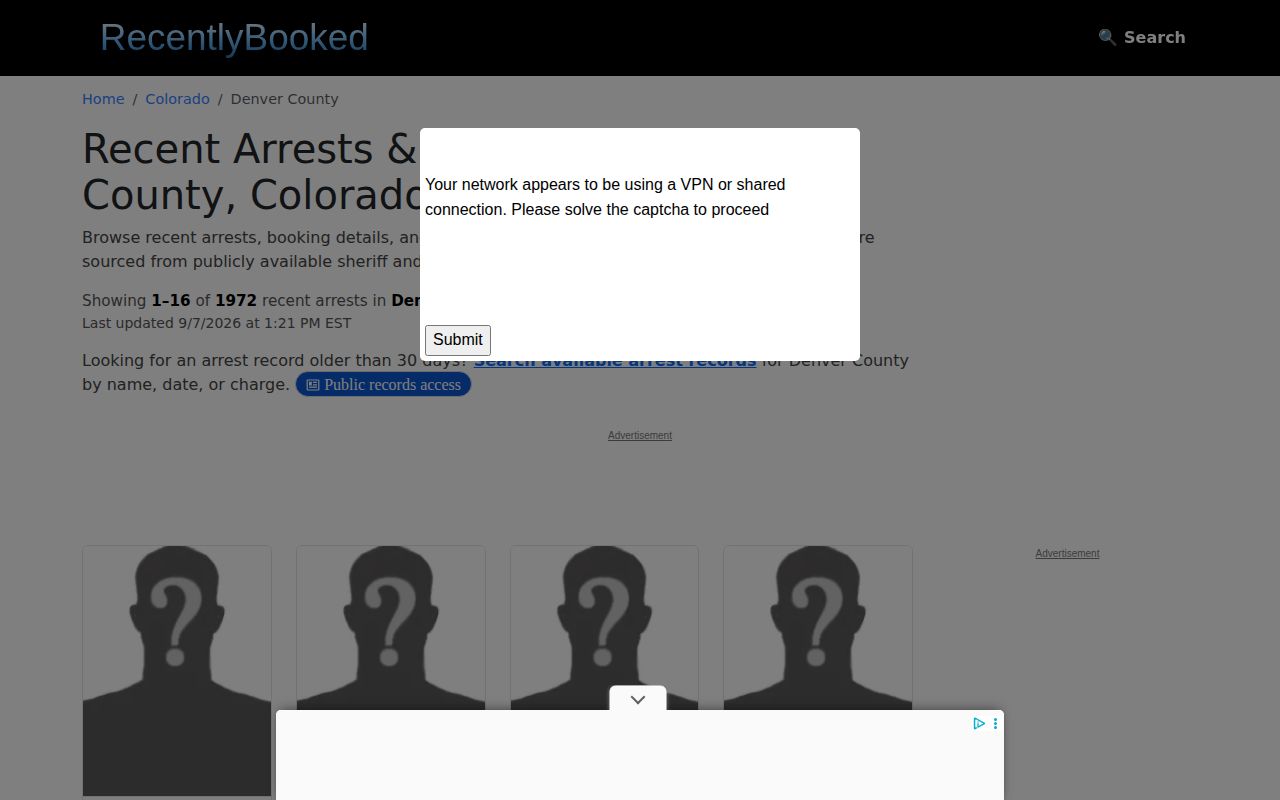
Third-party data runs stale, so confirm each item with DSD, DPD, or the court. Arrests.org offers statewide Colorado filters but no Denver-local section. Mugshots.com keeps a state index, and BustedNewspaper and Mugshots.zone list no Denver section. None is official. News outlets cover the city too. That includes the Denver Gazette arrest tag, Denver7 Crime, CBS Colorado Crime, and 9NEWS Crime. Their stories run on editorial timing, not a jail-posting schedule. DPD's crime dashboard, meanwhile, is incident data. It updates on a weekday pattern with a stated lag. It is not an arrest feed.
Denver Recent Arrests by City
Denver County is a consolidated city-county. There is one municipality, not several cities sharing a roster. DPD serves as the main police agency. People taken into local custody generally enter the Denver Sheriff system. The Denver Recent Arrests page connects DPD activity with DSD booking. Records, court, and news routes appear there too. No second city appears because none exists inside the county.
Denver County Arrest Record Fields
A booking record documents one intake event. It can tie a name to a booking number, date, agency, alleged offense, holding site, warrant reference, bond, or court identifier. DPD describes its recent arrest records as holding name, arrest dates, charges, fingerprint classification, booking numbers, and initial charges. Disposition stays with the court.
| Field family | Meaning |
|---|---|
| Name and numbers | Search identity, booking, and CD references |
| Booking and agency | Intake date and referring agency |
| Charges and warrant | Initial charge or warrant when populated |
| Facility and bond | Current site and available pretrial data |
| Court links | AB, docket, case, or appearance data |
| Disposition | Must be confirmed in court |
- Booking
- Administrative intake after arrest or transfer.
- Bond
- A court-set release condition.
- Disposition
- The recorded outcome, such as dismissal, plea, acquittal, or sentence.
- Detainer
- A request from another authority concerning custody or release.
A name alone rarely settles who a record belongs to. Victim details, juvenile material, sealed files, medical facts, NCIC/CCIC data, and identifiers may be lawfully withheld, so a blank field can signal a legal limit rather than a missing event.
Denver Mugshots and Arrest Photos
Denver's public custody roster shows no booking photos. That is a display choice, not a sign that none exist. The sheriff's roster simply lists who is in custody. For a photo tied to detention-center processing, the DPD Police Records page handles the request. Citation and release may follow a different processing path. It can leave no photo through that route. The records page is where Denver points arrest-record requests.
This route stands apart from the photo-less custody roster and any unofficial publisher. A CDOC profile can later add a state offender image. That happens after commitment or supervision. The picture may not be the Denver intake photo. The federal BOP locator offers no general public mugshot display, and U.S. Marshals policy restricts prisoner-photo release. No photo gallery appears here.
Request Denver County Arrest Records
Pick the custodian that matches the record type. The DSD Civil Liabilities Unit takes requests electronically on its public-record page. A phone call or social-media message is not a formal request. DPD offers online and mail options. Court records come through the court's own portal or records channel. The DSD instructions cover electronic filing, fees, and redactions. A narrow request helps staff find the material. Include dates, identifiers, and an exact record type.
- Select DSD for custody records, DPD for police arrest material, or court for outcome.
- Give the name, known booking number, date range, and record sought.
- Ask separately for a photo when appropriate, recognizing the processing limit.
- Review a fee estimate before authorizing broad research.
Fees depend on who holds the record. DSD gives one free research hour. Paper copies run $0.25 per page, with staff time up to $41.37 per hour. An older DPD mail form listed $15 for an arrest record and $9 for an arrest photo, while the current page cites a different $20 research context for some civil-liability requests. There is no single universal fee. DPD estimates five to ten business days for identification requests and longer for some civil-liability work, so check live terms before filing.
Colorado Arrest Law and Removal
Colorado's Criminal Justice Records Act, C.R.S. §§ 24-72-301 through 309, governs criminal-justice records. Arrest, charging, disposition, and release records count as official action. Those are generally open for inspection. Even so, the law does not require every field online, and sealed files, juvenile information, victim details, medical facts, NCIC/CCIC data, and identifiers may be restricted. C.R.S. § 24-72-305.5 targets booking photos published for payment or value for removal. DPD's form includes a related affirmation. Skip any paid-removal vendor. For sealing, Colorado Judicial's Seal My Case route covers qualifying no-charge arrests, non-convictions, municipal matters, convictions, and juvenile expungement.
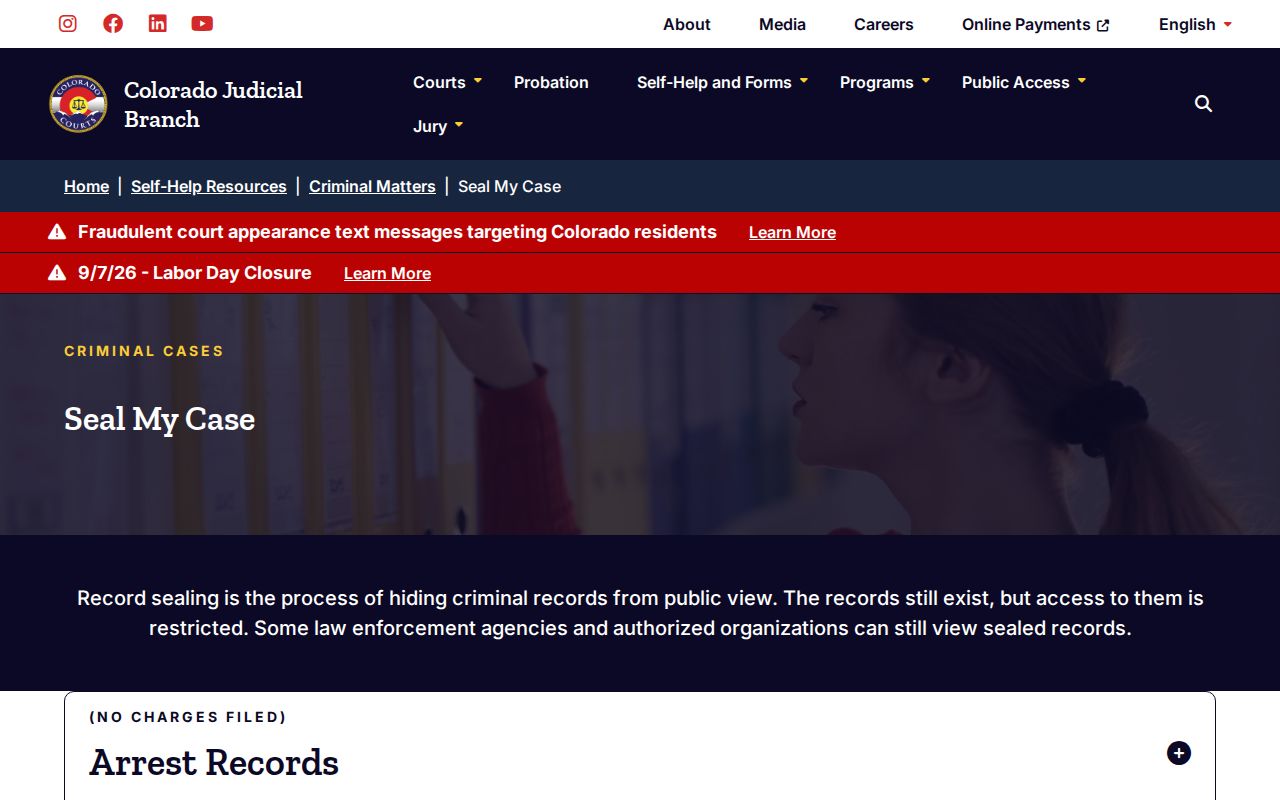
A court order does not fix downstream copies at once. Correct the official source first under C.R.S. § 24-72-307. Attach authoritative proof. If eligible, secure the order. Then use free publisher processes and, once the source changes, a search engine's outdated-content tool. RecentlyBooked describes a free route for incorrect, outdated, sealed, or restricted data, and Mugshots.com publishes free maintenance but lists no Denver page. Never pay anyone who promises guaranteed erasure.
Denver Arrest Record Retention
Denver's retention schedule separates what appears online from what the agency keeps. Major felony and violent-crime arrest records are permanent. Other felony arrests run ten years. Misdemeanor, petty, and traffic arrests last three years, and booking logs five. Sexual-assault arrest records are kept 99 years. Sexual-assault-on-a-child arrests are held permanently. Juvenile offender arrests stay on file until age 19. Litigation holds and approved destruction rules can alter that handling. None of this means the roster shows such history. Older material may sit with Denver records staff, Denver Public Library, or Colorado State Archives. Archives holds historical state correctional files and some photographs, not a current Denver booking archive. A vanished roster row does not prove destruction. Retained records are not always public in full.
Denver Arrest Warrants and Notices
Warrant lookups run through the courts in Denver. The court bonds page links a “Post Bond & Address Warrant” function. That is not a statewide or federal clearance. DPD keeps a central want/warrant file for justice agencies. There is no public version. Someone addressing a warrant should call the court or a lawyer. DPD's “Mug Shot Monday” posts are selected wanted notices, not a full new-booking feed. DSD lists no stable most-wanted gallery or update schedule. For an anonymous tip, the Crime Stoppers page is the route.
Do not approach or try to detain a wanted person. Call 911 for immediate danger, or 720-913-7867 to leave an anonymous tip.
After a Denver County Arrest
Denver County Court connects a booking to its outcome. Its criminal division runs seven days a week except holidays. That keeps appearances timely. The Public Portal can tie an AB booking number or case number to charges and dates. It also covers bonds, sentences, and case events. An arraignment handles charges and plea questions. Use the exact number, and confirm schedules since court dates can change. A disposition may record dismissal, acquittal, plea, conviction, or sentence. Court electronic copies are generally free under current guidance. Paper copies cost $0.25 per page, certification adds $20, and sealed-record limits still apply.
State and Federal Custody
A Denver booking starts in county custody. The Colorado Department of Corrections locator applies only after a state commitment or a supervision placement. Search by DOC number or exact name there. A Denver AB number will not work. A returned profile can carry an offender photo, the facility, conviction and sentence details, parole dates, and physical descriptors. Federal custody runs on separate systems. The BOP locator covers federal inmates without a general photo display, while ICE keeps its own locator for immigration detainees; match the tool to county detention, a state sentence, federal prison, or an immigration hold.
Why Denver Arrest Data Differs
A Denver arrest creates records in several offices, and they will never match field for field. The arresting agency writes its own report. DSD logs intake, facility, custody, and release. The court opens its own file once a matter reaches the judicial system. Updates rarely land at the same time, which is why the DSD roster can carry a charge the court later amends, and why DPD may hold a booking photo the public locator never displays.
Legal withholding opens other gaps. DSD treats juvenile records, victim information, sealed cases, medical facts, restricted databases, and personal identifiers as material it may withhold or redact. A sealed arrest returns a "No Such Records Exist" response. Take that answer at face value rather than speculating.
Denver's consolidated city-county form prevents a geographic slip. Neighborhood names do not create separate rosters. One DPD system handles policing. One DSD booking system handles custody. Nearby municipalities belong to their own counties and agencies, even when news coverage calls the whole area metro Denver.
Denver Bond and Release Checks
Bond is a court matter even when DSD custody data shows a summary, and Denver County Court publishes its bond route. Its bond division accepts qualifying bonds at the Downtown Detention Center under current instructions. Bond is a pretrial release condition, not a fine. It is not a sentence either. Release timing depends on court orders, other holds, identity checks, and facility processing. Never estimate release from a single roster row. Check the court portal for bond action. Review DSD custody and set VINE alerts. A person can have bond posted yet stay held for another valid reason, and a missing roster row says nothing about release or transfer.
Denver Sheriff Department Location and Directions
Public Record Search
Sponsored Results