
Denver Arrest Reports Across Days
The Denver Sheriff Department posts no official 72-hour, seven-day, or weekly booking blotter. The DSD Inmate Search works in the present tense. It shows who is held now, not an archive of everyone booked in a past date range. Denver Police publish no daily arrest log either. Their news and data products serve other purposes.
Start a multi-day search by naming the record you want. Custody questions go to DSD. The initial police arrest record sits with DPD Records. Charges, bond, and hearings belong to Denver County Court. Denver's retention schedule keeps arrest and booking logs for five years, but a historical log may still require an agency request.
Trace a Denver Arrest Report
With no Denver blotter to scroll back through, the trail runs from jail to police records to court. Exact identifiers matter. A name alone can match the wrong person.
- Check the official DSD roster for present custody. Save the search time, booking number, CD number, facility, and booking date shown.
- For a person no longer listed, submit a focused request through DSD Public Records or the DPD Police Records channel, based on which agency created the needed record.
- Use the AB booking number or case number in the Denver County Court Public Portal to locate court events and the eventual disposition.
- Compare any news story or unofficial entry with the agency and court material. Dates, charges, and custody status may have changed.
- For a truly old file, consult Denver's retention schedule and the relevant archive rather than relying on a copied web listing.
An arrest from just hours ago has a faster path. The Arrested Today page handles that. The multi-day method suits entries that have already rolled off the live custody view.
Denver Arrest Report Fields
One arrest report can pull fields from several systems. No single Denver public log promises the whole set, so the list below pairs each field with its best official context.
| Field | Meaning and source |
|---|---|
| Name and identifiers | Roster or arrest record; use booking, CD/inmate, AB, or case numbers to confirm identity. |
| Booking date and agency | Intake linkage, not necessarily the date a charge was filed in court. |
| Facility | Current Denver jail location, which can change after intake. |
| Charges | Initial charges in the booking record; court filings may differ. |
| Bond and court date | May appear in custody detail, but the court is the stronger source. |
| Photograph | Not shown in the public DSD roster reviewed; a DPD request is conditional on detention-center processing. |
| Disposition | Final case outcome from the court, not a reliable roster field. |
Court disposition is where a case's ending shows up. Charges, bond, and hearings fill the middle of a record, but the disposition explains how the case actually turned out.
Unofficial Denver Thirty-Day Listings
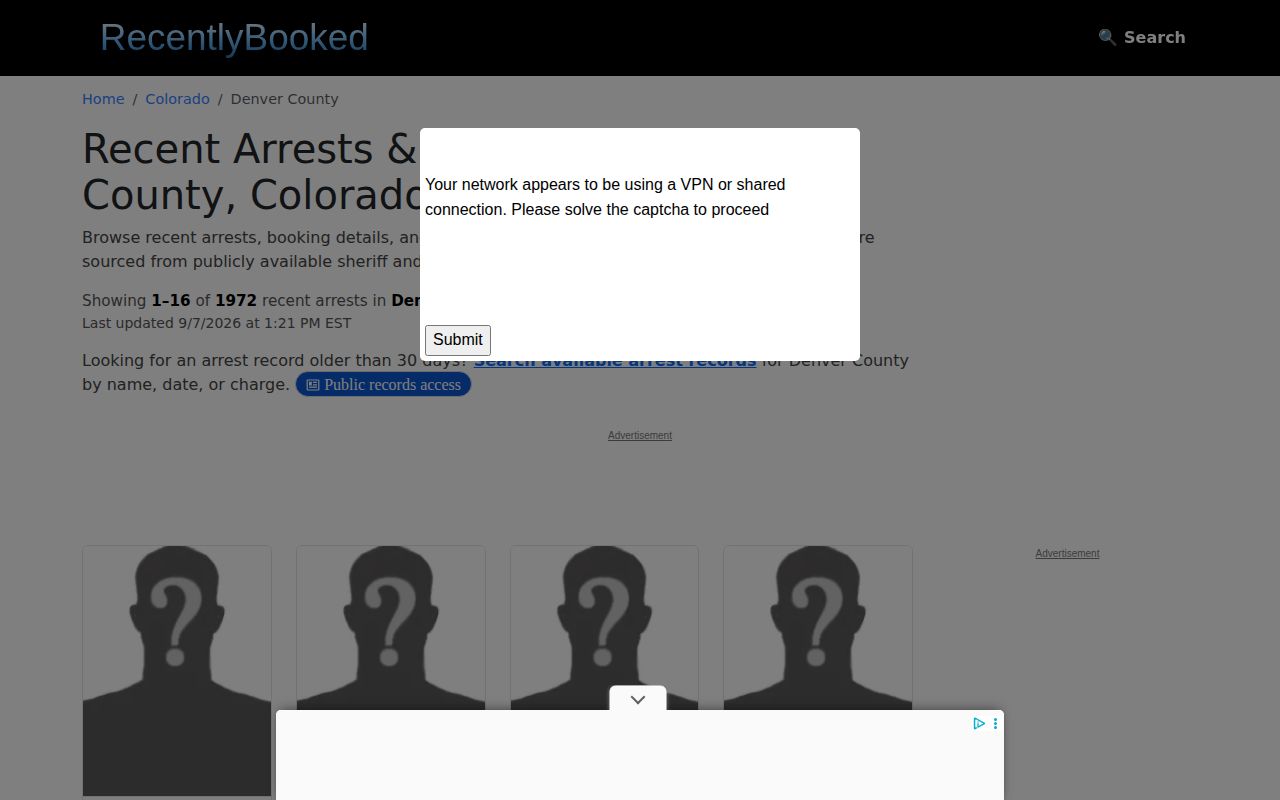
The strongest secondary multi-day lead is RecentlyBooked Denver. That listing offers a 30-day view of names and booking dates. Denver County supplies no official photos. Its refresh pattern is the publisher's habit, not an agency promise.
Treat the listing as a discovery lead only. It is not DSD, DPD, or county court. Entries can be late, incomplete, or stale. Check every relevant fact against a primary source. The publisher's own terms and FAQ describe its unofficial role and variable refresh timing.
The Denver section below shows how the unofficial listing presents its entries. View the source page for the Denver County aggregation.
Note: Nothing here replaces the custody search, records request, or court channels for a verified Denver arrest record.
Denver Arrest News Is Selective
News archives add context for major events. Editors choose what to cover, so the result is never a booking census. The Denver Gazette arrest tag gathers such stories in one place. So do Denver7 Crime, 9NEWS Crime, and CBS Colorado. Reports may draw on police statements, prosecutor releases, court records, scene images, or an agency-released photograph.
Dates can mislead. A story may run well after the arrest, booking, or filing. Coverage often reaches the wider metro area. Check the named agency and location before tying a story to a Denver booking.
The Gazette page is a topic archive. It is not a jail blotter. Open the source for the Denver Gazette arrest archive.
Note: Reported context helps, but the agencies and the courts hold the records that verify a Denver arrest.
Denver Crime Data Is Not Arrest Data
Denver Police crime dashboards count incidents under National Incident-Based Reporting System rules. The department updates them on weekdays, with a lag on the overall crime dashboard. None of that describes the jail roster. An incident can exist without any custodial arrest. A booking can also come from a warrant or another agency.
Maps and trend charts show where reported crime occurred. They cannot name everyone booked in a week. Reading the dashboard as an arrest feed mixes two data sets and risks false claims about individuals.
Note: Published crime-dashboard timing does not establish a Denver Sheriff booking schedule, including on weekends or holidays.
Denver Arrest Archives and Retention
How long does Denver keep an arrest file? The answer depends on the charge. Denver's General Records Retention Schedule sets five years for arrest and booking logs. Felony and violent-crime arrest records stay permanent. Other felony arrest records sit on the schedule for ten years. Misdemeanor, petty-offense, and traffic arrest records drop off after three. Some sexual-assault categories last far longer or never expire. Retention is a housekeeping rule, though, not a display promise. It tells the government how to manage a file. It does not put that booking entry on the public Denver Sheriff roster. Sealing orders, juvenile protections, victim details, medical material, and personal identifiers can all restrict access. A roster row that vanishes does not prove the record was destroyed. A retained file may still be withheld or redacted. Older arrests call for a different path. Start with the agency that created the record. Denver Public Library holds historical police collections reaching back decades. Its holdings are incomplete and only partly digitized. The Colorado State Archives keeps historical state correctional collections too. Prison files are no stand-in for a recent Denver County booking report.
Where Denver Arrest Records Persist
An arrest record outlives the roster entry. Once Denver Sheriff releases someone, that person may drop from the live list. The booking record stays on file with DSD or DPD. Prosecutors may have filed charges. Denver County Court then holds the docket, hearings, charge changes, bond action, and final disposition. Later custody matters too. If the person moves into state correctional custody or supervision, the search shifts systems. The Colorado Department of Corrections locator tracks that person. Federal and immigration cases run on entirely different systems. The federal Bureau of Prisons locator does not work as a Denver County booking archive. Neither does the ICE detainee locator. Pick the source that matches the person's custody status at the moment you search.
- Booking
- Jail intake that records identity, custody, and initial charges.
- Disposition
- The court's final outcome, which may differ from the booking charge.
- Retention
- The period an agency keeps a record, not the time it remains visible online.
- Sealed record
- A record whose public access has been limited by law or court action.
Read Denver Arrest Reports Carefully
Never match a record on a name alone. Check the booking number, arresting agency, booking date, facility, and court identifier together. Note the date you accessed it. Custody details shift fast. And keep any secondary source's claim apart from what an agency or court actually confirms.
The Denver County recent arrests hub shows how the pieces connect: the roster, the police record, a requested booking photo, the court file, and the custody systems that follow. No news archive or unofficial list can deliver the final result on its own. The 9NEWS crime page below offers one more example of event-driven local reporting. View the source for 9NEWS crime reporting.

Selected reporting may help trace an event. It still cannot stand in for a complete Denver County arrest log.